Tuesday, July 24, 2012

July 21, 2012 Shenandoah National Park to Manassas Battlefield to Arlington VA


The plan had been to spend the morning driving up the Skyline Drive enjoying the lovely overlooks and soaking in all of the mountain vistas.  Instead, the stead rain continued and rapidly, it became clear this would be a hard days's driving in the rain and fog, going perhaps 25 miles/hour and not being able to see much of anything.  This reminded Dick of a family trip on the Blue Ridge Parkway where we would dutifully stop at lookouts and read about what we were supposed to be seeing.  Fortunately we did see several more deer.

After a few miles, we changed plans into coming back down out of the mountains and heading directly up to Manassas Battlefield.  Today was the 151st anniversary of this first real battle of the Civil War.  Manassas is about 25 miles south west of Washington DC, and on that day in 1861, many Washingtonians drove down for the day to watch the battle. Rather like tailgaters for a football game.

Both the North and the South thought it was be a quick one-battle situation and that they would come out the victors having shown the other side what was what.  It didn’t go that way.

The biggest two things of the battle were confusion and loss of innocence. The confusion came from both armies being very green, and also because  especially it is early in the war there were no standardized uniforms:  troops wore whatever they had.   Being that many of the Confederate officers were from the US Army, they had US Army uniforms. There were also groups such as firefighters from New York who wore red shirts but fought for the North and southern troops with blue uniforms.

The loss of innocence came with the 4000 deaths and the clarity that this would be a long and very bloody costly war.

Because of the anniversary day, we saw many renactors for both North and South, including quite a powerful canon firing demonstration.  Did you know that it took a team of 4-8 men to service and shoot one canon?

We also sneaked in on a Daughter’s of the Confederacy special event, where they pledged allegiance to the  U.S. , to Virginia and to the confederacy.  They sang The Star Spangled Banner, Carry Me Back to Old Viriginy, and I Wish I Was in Dixie.    The women were wearing wide hats, expensive dresses, and some had on white gloves. Their keynote speaker was a historian from the National Park Service who told the fascinating story of Stonewall Jackson.  This was a glimpse into the current day feelings of some ancestors of those who fought in this long bloody war.  Some of it was very moving, some of it was highly uncomfortable to be witness to.

After the presentation, Dick had a chance to talk with renactors who played Robert E. Lee and Stonewall Jackson.  They talked about uniforms and their whole interest in playing these roles.  They were quite dedicated to acting authentically in these roles.

We went on a guided ranger talk where a young ranger took us around the battlefield where the main battle was held.  It was clear that the front lines were so close to one another, about 300 yards apart. These canons had the range of  1000 yards, so this was really point blank range. We heard that for years later, farmers would find bones and teeth when they would plow their fields, there were so many bodies.  This was also the battlefield where "Stonewall" Jackson was given his nickname when, in the face of a Union attach, he was described as standing there like a stonewall.  His unit repulsed the Union attack.

There was also the grave of a woman in her 80's who refused to leave her home and was killed when the Union blew the home up to stop sharpshooters from shooting at them.  Since her house was in the middle of the battleground, the first monument was placed in her backyard.  It recognized the patriots who had fought there.

The whole site was very moving.

We then went to the Manassas Museum and got to see another local view of the War.  A highlight there, was talking with one of the staff who was happy to give us the "Virginia view" of the War.  The National Park Service is very careful to be neutral in their interpretation, honoring both the North and South, noting that these were all Americans.  Many southerners are quite clearly still very hurt and bitter about the War.  Our docent was the lead for this exhibit and was quite willing to  share his views on a wide range of topics.

We then had a late lunch and drove on to Arlington, noting that we are now officially in the East and that the traffic is heavy and drivers are much less courteous than the southern ones we have been experiencing.

Getting ready for a couple days world-wind spin through Washington DC.

Monday, July 23, 2012

July 20, 2012 Williamsburg to Richmond VA to Monticello to Shenandoah Nation Park


Packing up the car after a couple days settling in, took a while, but we were then "off" again.

We wanted to add some stop at Richmond into our Civil War  agenda and found the perfect one:  The Richmond Battlefield Civil War visitor's center and The American Civil War Museum.  Two spots next door to one another in downtown Richmond.

These were placed in a  historic iron works.  This was a critical place that much of the iron needed in the Confederate war effort was made. Inside, it has been redone as a modern, amazing museum site.

The most powerful exhibit was one that put artifacts and recorded voices from both the military front and the home front in Richmond.  We have been hearing many of the military stories, which were moving and powerful.  But the home front voices were filled with stories we hadn't heard.  Near the end of the war, there was a "bread riot" in Richmond, where women rioted for food and had to be threatened with troops to calm down.  There was also quite a "Rosie the Riveter" kind of women moving into traditionally male occupied roles while the men were in the war effort.  85% of eligible males in the South were in the war, so there was a lot of work what now went either to women or to enslaved Africans or sometimes children.

We also heard in the next-door Civil War museum , much more of the African-American perspective on the War.  Fort Monroe, where former slaves were termed "contraband of War" was just the first place that enslaved Africans went to seek freedom from military sources.  Many of the Union batteries had large groups of "contrabands" that followed them. Some ended up joining up and serving in the military, others got jobs as servants or helping with laundry or cooking.  There was somewhere around 200,000 blacks troops in the army and 10,000 in the Navy.

Although earlier Patti had commented that we are not doing anything "in-depth" in the this trip, actually because we are visiting so many different places and especially sites of the Civil War, we are getting to borrow on knowledge and experience between sites and so the experience is becoming very in-depth, almost dizzyingly so at times.

Leaving the Civil War, it was time for an afternoon at Thomas Jefferson's home, Monticello.  We began thinking about Jefferson while at Colonial Williamsburg, but the afternoon had him on the forefront.  He designed and built this home and it was quite a reflection about him and is interests.

We were pleased to be able to go on a special "Behind the scenes" tour, going into areas the public generally doesn’t get to see including bedrooms on the second and third floors, the "dome room" , and into his wine cellar.  These areas we were able to take photos of, while you can't take them inside the public rooms downstairs.

The entire place was filled with inventions and cleverly designed things, such as a glass pair of doors, which open and closed when you move only one of them.  We saw his library and were told his wonderful quote "I cannot live without books.'  He said his after having his first library burn up, selling his second library tot he Library of Congress, so he then bought a full third library.

We also had a fascinating garden tour and learned about how Jefferson , the scientist, was also very interested in studying plants.  his vegetable garden was 1000 feet long and 30 feet wide.  Throughout the garden, plants were marked with traditional  little wooden labels saying their name, but many also had an additional "TJ" on the top indicating that Jefferson had grown this very type of plant.  others were marked with a L & C for plants that were brought back to him by Lewis and Clark on their exhibition.

Evening took up to the Skyline drive within the Shenandoah National Park. This lovely park was created in 1935 in order to give those urban east coast people a taste of western wilderness parks.  We were so pleased in driving along these Blue Ridge Mountains, to see many deer, including does with twins fauns.

The clouds hung low and then it began to rain, so we quickly settled into our campsite for the night and went to bed at 8:00.  A good night sleeps with the temp finally falling into the 60's.  Yah!

Sunday, July 22, 2012

July 19, 2012 Williamsburg VA


This morning we had the chance to do some catch up errands, look at some of the thousands of photos and try to make progress in the blogging. Then we went for a timeshare update breakfast.  Heard some of the latest news about timeshares...and got our two free tickets to Colonial Williamsburg.

Colonial Williamsburg is a nonprofit organization which has rebuilt and reconstructed the original downtown Williamsburg from back in the days of 1776.  The town is filled with living history character actors dressed in period costumes and lots of great professionally done show based on what was happening right as the Revolutionary War was coming.

Highlights of the day included the chance to tour the Virginia Capital Building where a lot of the decisions about the form of government that Virginia would have, and ultimately much of the whole movement to independence would have begun.


We also saw lots of other amazing building from coffeehouses to taverns, to private homes to stores.

We found some time to relax along the main street.

We had a long discussion with an actual wheelwright who makes wheels full time at Williamsburg, along with nearly 100 other craftsmen.

We timed our visit to have a visit with Martha Washington.  For her, it was shortly after her husband had retired after his second term as president.  She shared stories from throughout her life.  There were much personal sharing, even of being courted by George after her first husband had died.  She presented a very strong character who struggled with honoring her own thoughts and desires while being forced to play a more public, political role in support of her husband.

This time contrasted with a public meeting with George Washington later in the day.  For him, the time was 1775.  The colonies had not yet declared independence, he had not assumed command of the continental army, and he had not been President.  He shared his views on the conflict with the English Parliament and the sense of betrayal from the King.  He commented on the action in Boston to destroy tea and the English response.  We definitely had a sense of being transported back into that time.  After his speech, Mr. Washington took questions from the audience.  He was amazing in his ability to stay in character and rooted in the right time.  One question tried to draw him into speculating about time traveling and commenting on similarities between his time and ours.  George simply said, "I do not understand anything you just asked." The actors who played Martha Washington and George Washington were exquisite.  We were awestruck by their fine work and learned a lot.

In Virginia, much of the conflict was with the Governor, who was appointed by the King.  His palace was at the opposite end of town from the Capitol.  We thought about touring the Palace but, as a storm seemed to be moving in with lightening and thunder, we went back to the condo for dinner. NO real rain, but at least we had a nice dinner.

Then back to Colonial Williamsburg for evening program.  First we had a wonderful hour-long walking tour focused on Williamsburg and the Civil War.  Besides a lot of background about how part of the war was really was fought right in this town, there were also several additional renactors who brought the stories to life:  a shell struck Confederate young solider, a young wife whose husband was off in the Confederate army while she remained in Williamsburg under union occupation, and a Union martial law commander yelling at the the townspeople for aiding rebel troops as they came into town for raids.  The stories were complicated and compelling.

We then ended the evening with a lovely violin and harpsichord concert in the old Episcopal church where Washington and Jefferson attended worship in the 1700's.  It was a candlelit concert and filled the church with beautiful vibrations.

Then back to the condo for finishing up the days work, because tomorrow we are back on the move.

July 18, 2012 Norfolk VA NC to Williamsburg VA


We went to bed at 8:00 last night for a “nap” and ended up sleeping pretty much the night through.  Guess we were tired!  So we finally are getting the chance to catch up on our blog tonight (crossing our fingers anyway.)

We started this morning with another lighthouse, actually two.  These  were on a military base, Fort Story.  These were the old and new versions of: The Cape Henry Lighthouse.  The old one was the first one built by the US Federal Government in 1792.   Previous to this, the individual colonies or states had responsibility for building their own lighthouses, but this switched to a Federal responsibility.  This light station is at the entrance to the Chesapeake Bay.    We were there too early to go up it, but it was still fun to see.

The newer lighthouse replaced the old stone one.  Of course, it is much taller and has a much brighter light.  It was also interesting because it was a brick structure that was clad with metal sheeting.  Each lighthouse in the area has a distinctive black-and-white pattern.  This one was quite different from the patterns we had  previously seen. 

The first English settlers who ended up in Jamestown came ashore just a few hundred yards from the location where the lighthouse is now.  And, right off of this cape the French fleet fended off the British fleet that had arrived to reinforce the British army at Yorktown, leaving them trapped by Washington's army.

We headed north and got to the newest of American National Monument:  Fort Monroe in VA.  This place has been called The Freedom Fort, and was named a National Monument in November by Obama in part,  because early in the Civil War, three escaped slaves came to the fort asking to be safe.  Even though the Fugitive Slave Law required that they be returned to their owner, the Union commander of the fort, who happened to be an attorney, made the argument that because Virginia had seceded from the Union, the people were contraband of war and so could be confiscated rather than returned.   He was clear that he was against slavery, but trying to find a way to make a legal argument that would work. This was later confirmed by Congress.

As soon as the word went out about this, hundreds and then thousands of former enslaved Africans came to the Fort and the area surrounding it.  Included in this area was the famous Harriet Tubman who worked in the hospital there for a few months.

The fort was also famous because Robert E. Lee, who would become the commander of the Southern troops, was in charge of completing the building of this fort in the 1850's.  And after the war, Confederate President Jefferson Davis was imprisoned there.  AND Abraham Lincoln was at Ft. Monroe a couple of times.  A VERY cool civil War site!

We then spent the afternoon at Yorktown Battlefield in the Colonial National Historical Park.   This place was where basically the final battle in the Revolutionary War was fought, as well as a very decisive battle in the Civil War.  It was a very hot, but informative afternoon, driving through the battlefield listening to a well-done CD of two officers, one British, one American in a fictional reaction to the war.

We also had a wonderful discussion with a former Marine General from the San Diego area who now lives in Williamsburg, but volunteers at the Battlefield.  We were able to talk with him about our trip so far, and get some help and counsel from him on what Civil War sites were must see in the area.  He was so knowledgeable and we were yet again impressed by the amazing quality of people who volunteer with the National Parks.  Can you imagine getting a former general as a volunteer?

Just up the York River from Yorktown we found the location of the training station that Patti's father had attended shortly after his enlistment in the Navy at the beginning of the Korean War.  He had trained briefly in handling mines, for six weeks, but then the Korean War broke out and he was sent to the Far East to serve on a mine sweeper.  Patti had heard many tales of his time in this area so we were glad to find this site.  There were ships at this pier.

We went on to check into our very nice resort for the next couple of nights in Williamsburg.  This is now close to the half-way point of our trip, so we are giving ourselves the treat of a nice timeshare condo where we can really do our laundry, repack, consolidate our food, get caught up on our blog and photos and just rest up a bit.  Yah!  It is lovely and we cooked a great dinner with a full kitchen rather than warming up food in the microwave.  Tomorrow is off to see Colonial Williamsburg.


July 17, 2012 Ocrocoke NC to Norfolk VA


A full day driving up the Outer Banks of NC.  The night last night was less "buggy" than camping in the Everglades, but still quite buggy and very hot and stuff in the van.  Our van camping seems to work a lot better when it isn’t close to 100 degrees and humid.  We were able to really enjoy a lovely dawn sunrise walk on the beech, following the path just up from our campsite.  The sun on the water was shimmering with beauty.  As soon as it was fully up, Patti said, “Let’s try to catch the 7:00 ferry” to the next island, so we scrambled, drove about ten miles up the road and got on.

But, before we left we began seeing many rabbits grabbing something to eat from the grass before many of the campers began to stir.  We watched them for a few minutes before we had to leave.  They were very cute.

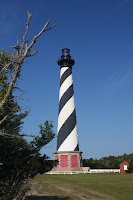
This took up to Hatteras Island, with swarms of tourists.  We were able to eat our breakfast cereal sitting on a bench waiting for the Cape Hatteras Lighthouse to open.  This is one  of the most famous lighthouses on the east coast.  Both for its distinctive black and white pattern, but also because in 1999 they moved it 2900 feet to keep it from being washed away into the ocean.  This was a huge task, because they didn’t take it apart, they jacked it up and moved it just like one might move a house or a rocket.  We got to see the movie they made about the move.  Crazy!  It was done primary using guys who were house movers from around the country-people who jack up houses, put it on a truck and take it someplace.

This is also the tallest brick lighthouse in the country and the second tallest in the world.  We were the first ones in to start of the walk of 279 steps up to the top.  It was quite a hike, and were where glad to be doing it in the morning rather than midafternoon.  We both made it.  Yah!  We heard form the ranger, that every summer they have to perform rescues on many people who are not in good enough shape to do this.  You wouldn't want to be on THAT list.

This lighthouse had been located a spot near the beach.  The ocean had eroded the island, until there was less than 100 feet of beach between the surf line and the foundation.  It was clear that if something had not been done, the lighthouse would have been lost.  So, they decided to move it - all in one piece. The Park Service hired the best house movers in the country to jack it up off its foundation and slowly move it 2900 feet.  It took several months to prepare it, move it, and set it in its new location.  They did a fine job, leaving only a ring of foundation stones at the old location.

Next we went to the Outer Banks’ other big claim to fame. This was the area where the Wright Brothers made their first mechanical airplane flight, outside of Kitty Hawk.  We saw the flat places where they did the first flights, in 1903. We had imagined that they flew off of a big hill, but in order for it to “count” as a flight, it need to start on flat ground.  And we also climbed to the top of the hill where there is a memorial to them.  The Memorial is quite moving.

One of the great park ranger activities was to take kids to the place where the first flight went for 120 feet in 12 seconds.  She then took a stopwatch and had any kids who wanted to run the same distance.  All of them proved they were indeed faster runners than the first airplane, including and couple of four year-olds.  So it didn’t go very fast. 

But we where struck as to reflected how the world had changed because of this leap:  being able to fly around the world or across the country without much thought. One of the sweetest things was a letter certifying that Neil Armstrong and Apollo 8 took with him to the moon a tiny piece from the first airplane that the Wright Brother’s flew.  How cool was that!

One more lighthouse filled out the day.  This one was at Currituck Beach Light, also on the Outer Banks.  This lighthouse was not painted but remains its original red brick.  It was open, so we walked up this 162 foot lighthouse. So that makes two tall ones in the same day.   To get to it, we got to drive through the community of Duck NC.  This place had more corny joke signs than we have seen in a while.

We were really appreciative of the great interpretation that was provided at the base and on the landings.  We have learned a lot about lighthouses but found some interesting new information in what was provided here.  As you can imagine, the spiral staircase gets much narrower as we neared the top.

By the time we got to Norfolk, just time for dinner and bed.  Goodbye Outer Banks!  We really enjoyed out visit.

July 16, 2012 Havelock NC to Ocracoke Island NC


Not quite as early morning as we would have liked.  Patti couldn’t quite stand getting out the door at 6:00 so we pushed things a bit further back and left around 8:00 or so.  First thing was a chance to take a little ferry (more like large boat) out from Hawkers Island to see The Cape Lookout Light.  In order to see the lighthouse, you have to go to this island.  The lighthouse is a lovely, black and white diamond design.  Because we slept in, we wouldn’t have time to walk around on the island, but they were happy to have us ride out and then come back.  One of the fun parts was that we went along with a boatload of North Carolinian surfers.  We got to talk with thee seven young surfers about surfing here verses San Diego. One guy had been in Ocean Beach in San Diego County and he confirmed, yep, it is a LOT colder in CA than here in the water.

We were then able to go to the Cape Lookout National Seashore visitor center.  There we met a delightful couple that was volunteering at the center for the summer.  Last summer they spent volunteering at Dick’s favorite of all of the National Parks:  the Grand Tetons.  We enjoyed swapping stories with them about parks and then time to go:  we had another ferry to catch.

 On our return from Cape Lookout, we detoured to slowly pass by Shackleford Island.  This is the island with a herd of wild horses which were descended from Spanish horses which had swum ashore from ships sunk off the outer banks.  There were over 100 horses on the island and we were able to catch a glimpse of a couple which were grazing near the shore.  It was an exciting moment for us.

The next couple of days will be spent on what is known as The Outer Banks of North Carolina.  If you look at a map, these are tiny little islands that stretch all along the coast of North Carolina, and are reachable by bridges midway and at the top, but by ferry  lower down.  They were very isolated for many years, and turned into primo vacation sites for people on the East coast.  

This one was a real large ferry going out to Ocracoke Island.  We saw its sister ferry going the other way.  It took nearly 2 hours and Dick was enchanted by spending most of it on the deck and chatting with the crew.  He so enjoys watching the waves and trying to figure out where we are going.

Once on the island we found our way to a beautiful lighthouse, the Ocracoke Light. There is a lovely lighthouse on Ocracoke and we saw it this afternoon.  The only real trouble was it is in the midst of the busy touristy section of town and we could hardly get a parking spot.   This whole Outer Banks area of NC is filled with treacherous water, because there are so many shallow areas and sandbars.  Hundreds of ships have crashed there over the years, so we had a lot of respect for the ferryboat captain who seemed to know where to go and what areas to avoid.


Landing on the island, we got the chance to settle in and chose a campsite at the National Park service campground.  This was right backed up to the beach and we were able to take advantage of this to take an afternoon swim.  There were signs that there were sea turtle nests in the area.  We love the fact that they are watching out for these sea creatures.

We were so glad to get some photos and then retreat to our quiet campground. The park ranger gave us some really food-oriented advice as to places for dinner on the island.  We couldn't think if we had ever met a park ranger who was a foodie before.  We chose a lovely place for dinner The Back Porch restaurant.  We both had lovely food, served by a great young woman who was getting ready for her final class before she completed nursing school.  We both know what an accomplishment that is, and gave her lots of encouraging words.  While we were at dinner, we heard about a storytelling program that would be happening in the evening. This would be at The Deepwater Theater. This would feature a father and daughter storytelling pair, Philip and Amy Howard, telling stories about living on the island.  They were joined by a fiddler player.  Sounded perfect to us, and so we spent a couple of hours listening to some great local lore including about some of their ancestors, a true ghost story from the island, and tales about hurricanes.  Lots of fun.  Patti even got to be interviewed for a videoblog by another storyteller, who it turns out Patti is FACEBOOK friends with.  What a small world.


Thursday, July 19, 2012

July 15 Yemassee SC, Charleston SC to Havelock NC


Awake early.  Yes, this is a theme of the trip, but another great day ahead so we wanted to get started.  What a way to spend a Sunday!

Today's main event was to get a good taste of Charleston, SC.  The very first thing we needed to do on our Civil War trek was to take the ferry out to see Fort Sumter.  The firing on the fort, located at the mouth of the Charleston harbor, was the official beginning of the Civil War.  The boat ride to the fort gave us the chance to have a harbor tour of the beautiful Charleston area, which is filled with lots of interesting history and lovely buildings.

The fort is on a man-made island, built as part of the coastal defense that was deemed necessary after the War of 1812.  This fortification was just being completed in early1861.  It was built to prevent an attack from the sea, not from the surrounding lands.  A small contingent of Union troops were manning both Sumter and a nearby fort when South Carolina decided to leave the Union.  Many of the fort's guns had not be assembled and most of those that were ready were aimed toward the ocean.

The North tried to reinforce the garrison prior to Lincoln taking office but the ships were turned back. The fort's commander then consolidated his force at Sumter, which really upset the Confederate leaders.  Lincoln sent another supply ship, this one was not a war ship.  The Confederacy demanded the surrender of the fort, which was refused.  The South opened fire just before the supply ship arrived.  Guns fired for 34 consecutive hours.  Not much damage was done to the walls of the fort but many interior buildings were set ablaze, including one over the powder magazine.  The fort's commander decided to surrender.  Despite the shelling, no Union troops were killed but two were lost when one gun exploded during the surrender ceremony.  The troops boarded the supply ship and sailed north.  The battle was over and the war had begun.

The Union tried for the next several years to retake the fort.   They landed a force on a nearby island and set up seize guns that were much more powerful than what the Confederate forces had used in the earlier battle.  These guns reduced the brick fort from three stories to one.  The fort held out until Sherman's Army approached from the South..  The fort was modified for coastal defense during the Spanish-American War, and again in World Wars I and II.

What we saw was quite different from the way it looked in 1861. It was still quite moving to be on this place where this war that would rage for four years started.  Everyone was quite subdued while visiting.

After returning to our car, we took a slow drive around the old part of the city.  We liked the squares of Savannah better but the homes here, especially along the harbor, were very impressive.  They have obviously done much to restore and maintain these grand old homes.

Patti was not in the mood to tour more houses, like we had done yesterday in Savannah.  She was quite pleased to find the perfect afternoon activity:  to visit The Boone Hall Plantation outside of Mt. Peasant.  This was originally a plantation where they grew indigo and later they raised pecans.  They also were a major brick producer.  Many of the homes in Charleston were built using these bricks.  Enslaved Africans who had been brought there to work did most of the work in the fields and in the brick plant.

The most moving part of the entire plantation was a new exhibit which was located in each of nine of the original slave homes.  These had exhibits, narration, and sometimes video program on different aspects of African-American life including home and family, religion, archeological finding about life for enslaved people on plantations, emancipation, life after the war, the Civil Rights Movement, and a deeper political understanding of the institution of slavery and its painful legacy.  

There was also a fine theatrical program on The Gullah culture of the Carolinas, which was a specific black culture that has its roots in Africa.  As part of this program, Patti got to go on stage and help to play along on a djembe African drum.  She was very pleased to be able to do this, because she plays drums at home.

The remainder of the plantation was rather anticlimactic after these powerful presentations.  We did enjoy getting out of the heat to tour the bottom floor of the plantation-style house, built in the 1930's.  We got to hear some more about the families who had lived in and owned this property.

One of the crafts that the blacks of the 1800s had done in this area, was to make sweetgrassbaskets.  This is something that continues on, and the highway we drove on was called The Sweetgrass highway.  We stopped and bought a lovely basket from a woman who shared that she was the fifth generation in her family to be making these baskets.

We made one more stop along the coast of South Carolina, we wanted to see a couple of lighthouses.  We followed a number of small country roads to the shore where we found the Oak Island Lighthouse.  It replaced a very old structure across the Fear River.  We could see the old structure but could not get close to it.  We enjoyed talking with two couples along the boardwalk to the beach.  The second couple had only been married a few days and were on their honeymoon.  We were happy to take their picture with the tall lighthouse in the background.

Then we had a long drive to Havelock, NC, near the Marine Base Camp Lejeune. We were both glad to arrive and fell into bed.